
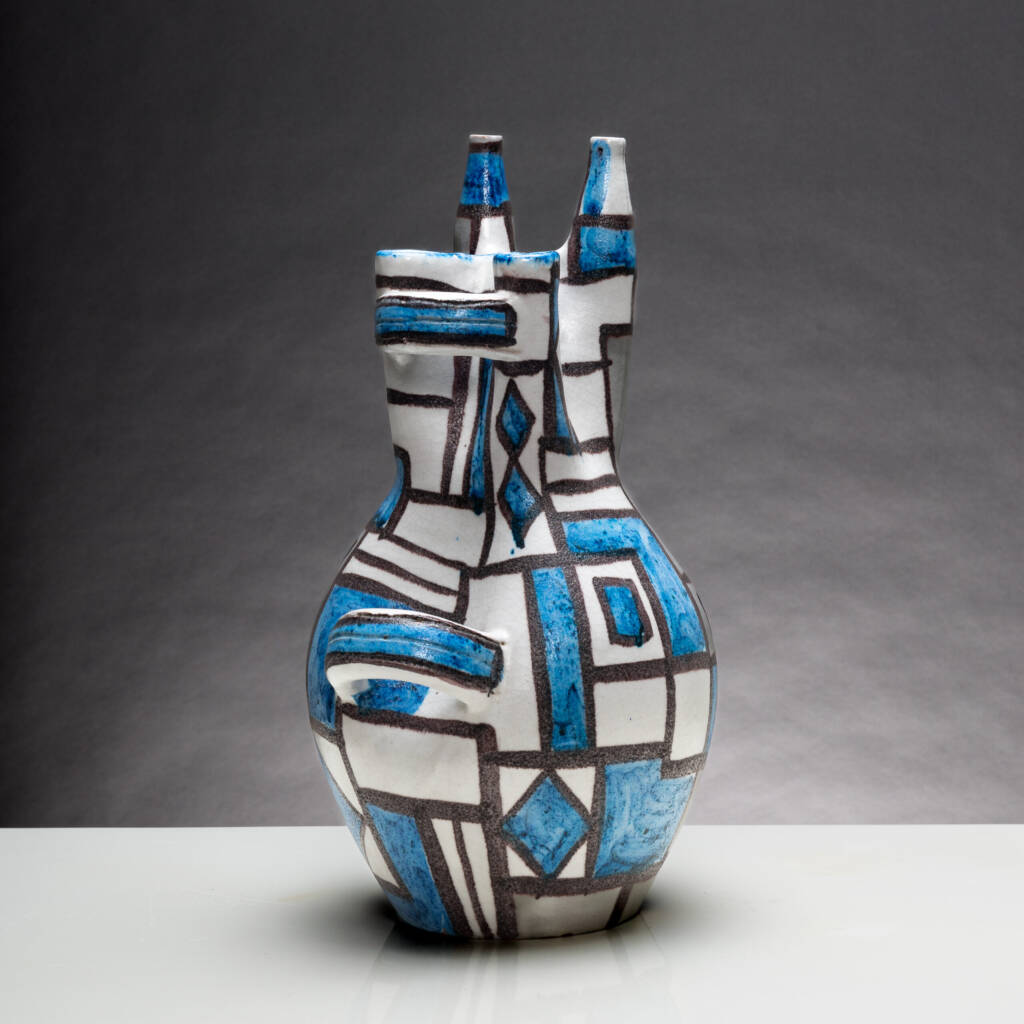
Glazed ceramic vase by Guido Gambone (1909–1969)
Italy, Florentine period, circa 1950–1960
Hand-painted ceramic vase with a generous silhouette, structured by a double vertical neck and a subtly integrated lateral handle, giving the piece an architectural presence.
The surface, covered in a slightly crackled white glaze, is animated by a geometric decoration composed of thick, slightly vibrating black lines forming an interlocking network of shapes — rectangles, lozenges, and vertical bands. Areas of deep blue punctuate the composition, enhancing its graphic contrast.
Conceived as an autonomous work, the piece reflects Guido Gambone’s exploration of a free decorative language, in which pattern and volume are intrinsically linked.
Guido Gambone (1909–1969) is regarded as one of the most important Italian ceramicists of the 20th century. Born in Campania, he trained within the artisanal tradition before establishing himself as a major figure in the renewal of Italian ceramics in the postwar period.
The so-called “Florentine period” corresponds to a phase of artistic maturity, when Gambone settled and worked in Tuscany, particularly in Florence.
Gambone used several signatures, the most recognizable being the small stylized donkey, which has become emblematic of his work and is especially associated with his most sought-after pieces today.
Details
You should know
Signed under the ceramic “GAMBONE ITALY” – Donkey Mark – Original label with reference | Good original condition
Specifications
- Period
- Around 1950 - 1955
- Dimensions
-
Height: 16 47/64 in. (42,5 cm)
Width: 16 47/64 in. (24 cm)
Depth: 9 27/32 in. (25 cm)